
Introduction
Choosing the right accounting platform is one of the most important operational decisions a small business can make. Whether you are a newly self-employed sole trader, a growing limited company, or an established SME, your accounting software directly affects cash flow visibility, tax compliance, and day-to-day efficiency. In the UK market, sage accounting software remains one of the most recognised and widely used solutions—but recognition alone does not guarantee it is the right choice for your business in 2026.
This sage accounting software review is designed to give you a clear, practical, and unbiased assessment of how Sage performs today. Rather than focusing on surface-level features, this guide looks at how Sage works in real business scenarios: invoicing clients, managing expenses, submitting VAT returns, collaborating with accountants, and planning for growth.
With increasing HMRC digitalisation, Making Tax Digital requirements, and tighter compliance expectations, accounting software is no longer optional. Businesses now need reliable systems that reduce errors, store digital records correctly, and submit accurate information on time. Sage bookkeeping software has been built around these needs for decades, which is why it continues to be trusted by accountants and finance professionals across the UK.
However, competition has increased significantly. Many business owners now ask whether Sage still holds up against newer cloud-first platforms. Is sage the best accounting software for sole traders? Does it offer enough value for small limited companies? Are the features easy enough for non-accountants? And is the pricing justified in 2026?
Throughout this sage accounting software review, we will answer all of these questions in detail. We will also explain the available pricing plans, highlight real advantages and limitations, and show how you can reduce costs using the current Sage promotion. At the time of writing, eligible businesses can get 3 months free, making it far easier to test Sage without a long-term financial commitment.
👉 You can view the current Sage offer here:
https://accountingsoftwaredeals.co.uk/recommends/sage-offer/
(Subject to eligibility; offers may change—always check current T&Cs.)
By the end of this guide, you will know exactly whether sage accounting software fits your business needs in 2026 and whether it deserves a place at the centre of your financial operations.
Contents
- What is Sage Accounting Software?
- Who is Sage Best For in 2026?
- Key Sage Accounting Software Features
- Sage Bookkeeping Software for Sole Traders
- VAT, MTD & HMRC Compliance Explained
- Ease of Use & User Experience
- Pricing, Plans & Value for Money
- Integrations & Add-Ons
- Sage vs Competitors: Is Sage the Best Accounting Software?
- Pros and Cons of Sage Accounting Software
- Security, Support & Reliability
- Promotion Conditions & Offer Details
- General FAQs About Sage Accounting Software
- Recap: Sage Accounting Software Review
- Conclusion: Should You Choose Sage in 2026?
What is Sage Accounting Software?
Sage accounting software is a cloud-based accounting and bookkeeping platform developed to help UK businesses manage their finances accurately, securely, and in line with HMRC requirements. Sage has been operating in the accounting software market for over 40 years, giving it a depth of experience that few competitors can match.
In its current form, Sage Accounting is designed for sole traders, small businesses, and SMEs that want an all-in-one system for bookkeeping, invoicing, VAT management, reporting, and financial compliance. Unlike spreadsheet-based accounting or basic bookkeeping apps, Sage provides a structured accounting framework that mirrors how professional accountants work.
At a functional level, sage accounting software allows businesses to:
- Record income and expenses in real time
- Connect business bank accounts for automatic transaction feeds
- Create and send invoices and quotes
- Track unpaid invoices and overdue payments
- Calculate and submit VAT returns digitally
- Generate financial reports for decision-making and tax preparation
One of the reasons Sage remains so popular is its strong alignment with UK accounting standards. The software is built around HMRC rules rather than adapting to them later, which reduces the risk of non-compliance.
It is important to distinguish Sage Accounting from Sage’s legacy desktop products. This sage accounting software review focuses on the modern cloud-based Sage Accounting platform, not older desktop versions that required local installation.
For businesses that want dependable bookkeeping software with a proven track record, Sage offers reassurance, continuity, and long-term support—qualities that are increasingly important in an environment of frequent regulatory change.

Who is Sage Best For in 2026?
Sage is best suited to UK businesses that prioritise accuracy, compliance, and scalability over minimalism. In 2026, its strongest user profiles include:
Sole traders planning for growth
Many self-employed professionals start with spreadsheets or very basic bookkeeping tools. Sage bookkeeping software provides a natural step up for sole traders who want better organisation, clearer tax records, and easier collaboration with accountants.
VAT-registered businesses
If your business is VAT registered—or likely to become so—sage accounting software is particularly effective. Its VAT tools are comprehensive, flexible, and fully compliant with Making Tax Digital.
Small limited companies
Company directors often need clearer reporting, stronger audit trails, and better expense management. Sage’s reporting structure supports these needs well.
Businesses working with accountants
Because Sage is widely used by UK accountants, it reduces friction when sharing data, reviewing accounts, or preparing year-end submissions.
Sage may not be ideal for:
- Businesses that want the cheapest possible accounting tool
- Users who prefer ultra-minimal interfaces
- Very early-stage side hustles with minimal transactions
For those businesses, lighter alternatives may feel simpler. However, for long-term stability, many users find Sage grows with them better than entry-level tools.
Key Sage Accounting Software Features
The depth of sage accounting software features is one of its strongest advantages. Rather than offering isolated tools, Sage delivers an integrated accounting environment.
Invoicing and sales management
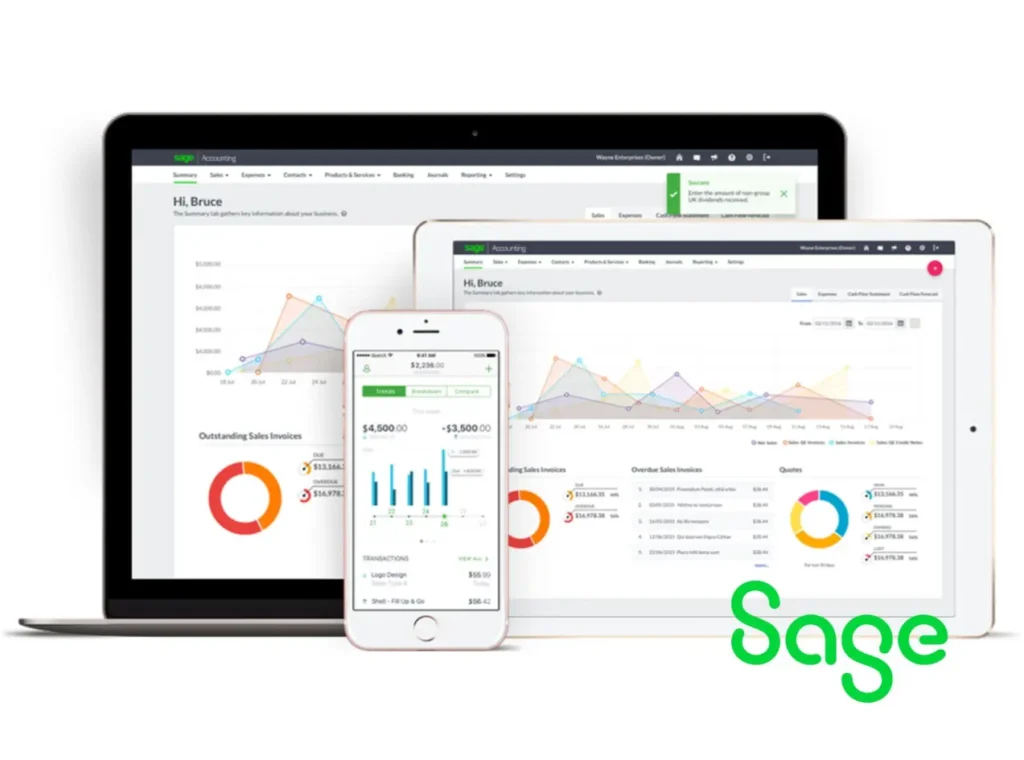
Sage allows users to create professional invoices, customise branding, set payment terms, and automate recurring billing. Invoices can be sent directly from the platform, reducing administrative time and improving cash flow tracking.
Expense management and receipt capture
Expenses can be logged manually or imported via bank feeds. Users can attach digital receipts, categorise costs, and ensure expenses are correctly recorded for tax purposes.
Bank feeds and reconciliation
Secure bank feeds automatically import transactions from UK banks. Sage matches these transactions to invoices and expenses, speeding up reconciliation and reducing errors.
Cash flow forecasting
Cash flow visibility is essential for small businesses. Sage provides forecasting tools that help predict future balances based on invoices, bills, and recurring costs.
Reporting and insights
Sage generates profit and loss reports, balance sheets, VAT summaries, and other financial statements. These reports help business owners understand performance and prepare for tax obligations.
These sage accounting software features make it a comprehensive solution rather than just a bookkeeping app.
Sage Bookkeeping Software for Sole Traders
For sole traders, Sage bookkeeping software offers a structured way to manage finances without requiring accounting expertise. The platform simplifies everyday tasks while maintaining professional-level accuracy.
Sole traders benefit from:
- Clear income and expense categorisation
- Digital record keeping for Self Assessment
- Easy tracking of allowable expenses
- Reduced reliance on spreadsheets
Sage also helps sole traders build better financial habits. By keeping records up to date throughout the year, tax returns become easier and less stressful.
Although Sage may feel more detailed than entry-level tools at first, many sole traders appreciate the control and clarity it provides as their income increases.
VAT, MTD & HMRC Compliance Explained
HMRC compliance is a core strength of sage accounting software. Sage is fully compatible with Making Tax Digital for VAT, allowing businesses to submit VAT returns directly to HMRC without manual re-entry.
Supported VAT schemes include:
- Standard VAT
- Flat Rate Scheme
- Cash accounting
Sage calculates VAT automatically based on transaction data, reducing the risk of mistakes. Digital records are stored securely, meeting HMRC’s MTD requirements.
For businesses concerned about compliance penalties, Sage’s approach provides peace of mind.
Ease of Use & User Experience
User experience is often subjective, but Sage prioritises clarity and accuracy over visual minimalism. The interface is structured, logical, and designed to reflect traditional accounting workflows.
New users may experience a learning curve, but Sage provides extensive support resources. Over time, many users find Sage easier to manage as business complexity increases.
Pricing, Plans & Value for Money
Sage pricing is competitive rather than cheap. Plans typically scale based on features such as VAT, reporting, and multi-user access.
The availability of a 3 months free promotion makes Sage far more accessible for new users in 2026.
👉 View the current Sage offer here:
https://accountingsoftwaredeals.co.uk/recommends/sage-offer/
(Subject to eligibility; offers may change.)
Integrations & Add-Ons
Sage integrates with payroll systems, payment processors, CRM tools, and e-commerce platforms. This flexibility allows businesses to build a connected financial ecosystem.
Sage vs Competitors: Is Sage the Best Accounting Software?
When comparing Sage to Xero, QuickBooks, or FreeAgent, the question is not which is objectively best, but which suits your business model.
Is sage the best accounting software? For compliance-focused UK businesses that want long-term reliability, Sage remains one of the strongest options available.
Pros and Cons of Sage Accounting Software
| Pros | Cons |
| Excellent HMRC and VAT compliance | Slight learning curve |
| Trusted UK accounting brand | Not the cheapest at standard pricing |
| Strong reporting and scalability | |
| Accountant-friendly platform |
Security, Support & Reliability
When choosing accounting software, security and reliability are just as important as features and pricing. Sage accounting software has a long-standing reputation for stability, and in 2026 it continues to prioritise data protection, system uptime, and dependable customer support for UK businesses.
From a security perspective, sage accounting software operates on encrypted cloud infrastructure designed to protect sensitive financial data at every stage. Business information is encrypted both in transit and at rest, helping to prevent unauthorised access. Regular automated backups ensure that financial records are protected against data loss, system failure, or accidental deletion—an essential safeguard for sole traders and SMEs that rely on accurate bookkeeping records.
Access controls within Sage bookkeeping software allow business owners to manage who can view or edit financial data. This is particularly important for companies working with external accountants or bookkeepers, as permissions can be tailored to specific roles. These controls help maintain confidentiality while still enabling collaboration.
Reliability is another area where Sage performs strongly. As one of the most established accounting providers in the UK, Sage has invested heavily in infrastructure designed to deliver consistent performance and high availability. For businesses that depend on their accounting software for invoicing, VAT submissions, and cash flow tracking, this reliability reduces operational risk and downtime.
In terms of support, Sage offers a combination of self-service resources and customer assistance. Users have access to online knowledge bases, step-by-step guides, and community forums, alongside UK-focused support options. This blend of support is particularly useful for small business owners who want answers quickly without always needing to contact an accountant.
Overall, this sage accounting software review highlights security, support, and reliability as key reasons why many businesses continue to trust Sage. While no cloud platform is completely risk-free, Sage’s approach provides reassurance for businesses that need a dependable, compliant, and secure accounting system.
Promotion Conditions & Offer Details
As part of this sage accounting software review, it is important to clearly outline the conditions attached to the current Sage promotion. At the time of writing, Sage is offering eligible users 3 months free, which can significantly reduce the cost of getting started with sage accounting software.
Typically, this introductory offer is:
- Available to new Sage customers only
- Limited to a fixed introductory period, usually the first three months
- Applied to selected Sage Accounting subscription plans
- Subject to Sage’s current terms and conditions
After the discounted period ends, subscriptions usually revert to standard pricing, unless cancelled beforehand. This makes the offer particularly attractive for sole traders and small businesses that want to test sage bookkeeping software in real-world conditions before committing to the full cost.
It is important to note that promotions are subject to change and may vary depending on region, plan type, or eligibility criteria. For this reason, businesses should always review the latest terms and conditions directly on Sage’s website or through an authorised partner before signing up.
👉 You can check the latest Sage offer here:
https://accountingsoftwaredeals.co.uk/recommends/sage-offer/
This type of promotion can make sage accounting software far more accessible, especially for new businesses that want professional accounting tools without a high upfront investment. However, as with all software offers, careful review of pricing after the promotional period is recommended to ensure ongoing value.
Subject to eligibility; offers may change—always check current T&Cs before signing up.
General FAQs About Sage Accounting Software
Is Sage suitable for sole traders?
Yes. Sage bookkeeping software is well suited to sole traders who want structured accounting and HMRC compliance, especially if they plan to grow.
Does Sage support Making Tax Digital?
Yes. Sage accounting software is fully MTD-compatible for VAT submissions.
Is Sage cloud-based?
Yes. Sage Accounting is cloud-based and accessible from any internet-connected device.
Can my accountant access Sage?
Yes. You can grant access to your accountant or bookkeeper with controlled permissions.
Is there a free trial?
Sage often offers discounted introductory periods rather than long free trials. Check current offers.
What does the 90% off offer include?
Typically, it applies to subscription fees for the first 3 months. Subject to eligibility and T&Cs.
Can I cancel after the discounted period?
Yes, but cancellation terms depend on your subscription. Always check current conditions.
Does Sage handle VAT Flat Rate Scheme?
Yes. Sage supports multiple VAT schemes, including Flat Rate.
Is Sage good for limited companies?
Yes. Sage is widely used by UK limited companies.
How secure is Sage?
Sage uses strong encryption and secure data centres.
Does Sage include payroll?
Payroll is available as an add-on rather than included in base plans.
Is Sage better than Xero?
It depends on your needs. Sage excels in compliance and structure, while Xero focuses on design and integrations.
Can I switch to Sage from another platform?
Yes. Sage provides tools and guidance for migrating data.
Recap: Sage Accounting Software Review
This sage accounting software review shows clearly why Sage continues to be one of the most trusted accounting platforms for UK sole traders and small businesses in 2026. Across invoicing, expense tracking, VAT submissions, and financial reporting, sage accounting software delivers a structured and compliant approach to managing business finances that many newer tools struggle to match.
For sole traders and SMEs, the biggest strengths of Sage lie in its reliability, HMRC alignment, and depth of functionality. Sage bookkeeping software goes beyond basic income and expense tracking, offering proper accounting workflows that help businesses stay organised throughout the year rather than scrambling at tax time. Features such as bank feeds, VAT scheme support, cash flow forecasting, and accountant access make Sage particularly valuable for businesses that want to grow without needing to switch platforms later.
This sage accounting software review also highlights that Sage is not necessarily the cheapest option at standard pricing, and it may require a short learning curve for complete beginners. However, for businesses that value compliance, accuracy, and long-term scalability, those trade-offs are often worthwhile. When considering sage accounting software features as a whole, Sage stands out as a dependable solution built for the realities of running a UK business.
With the availability of introductory discounts, including significant short-term savings, Sage becomes even more accessible for businesses that want to test whether it fits their workflow before fully committing.
Conclusion: Should You Choose Sa6ge in 202?
If you are looking for dependable, HMRC-compliant accounting software that can support your business as it grows, Sage remains a strong and credible choice in 2026. For many UK sole traders and small companies, the real question is not simply is sage the best accounting software overall, but whether it is the best accounting software for their specific stage of business—and in many cases, the answer is yes.
Sage accounting software is particularly well suited to businesses that want clear financial visibility, accurate bookkeeping, and confidence that their VAT and tax obligations are being handled correctly. Its long-standing reputation, combined with modern cloud functionality, makes it a reliable option for those who prefer stability over trend-driven tools. Sage bookkeeping software also works exceptionally well when collaborating with accountants, which can save time, reduce errors, and lower professional fees in the long run.
While Sage may take slightly longer to learn than ultra-simplified platforms, its comprehensive feature set and compliance-first design make it a smart long-term investment rather than a short-term fix. When you factor in current introductory pricing, the risk of trying Sage is relatively low compared to the potential benefits.
👉 Check the latest Sage offer here:
https://accountingsoftwaredeals.co.uk/recommends/sage-offer/
At the time of writing, eligible users can get 3 months free, making it easier to explore sage accounting software features in a real business environment before paying full price. Subject to eligibility; offers may change, so always review the current T&Cs before signing up.
- Zoho Books Accountancy Software Review
 Introduction Choosing the right accounting platform is one of the most important decisions a sole trader or small business can make. Your software underpins how you invoice customers, manage expenses, track cash flow, submit VAT returns, and ultimately understand whether your business is profitable. In this zoho books accounting software guide, we provide a comprehensive,… Read more: Zoho Books Accountancy Software Review
 - Xero vs Zoho Books for Small Businesses (2026)
 Introduction Choosing accounting software is one of the most important decisions a sole trader or small business owner can make. The right platform saves time, reduces stress around tax, and gives you clearer insight into cash flow and profitability. The wrong one can feel restrictive, confusing, or unnecessarily expensive as your business grows. That’s why… Read more: Xero vs Zoho Books for Small Businesses (2026)
 - Zoho Books vs Sage for Small Businesses (2026 Comparison Guide)
 Introduction Choosing the right accounting software is one of the most important early decisions a sole trader or small business can make. The right platform can save hours each month, reduce accounting fees, improve cash flow visibility, and ensure you stay compliant with UK tax rules. The wrong choice can lead to frustration, missed deadlines,… Read more: Zoho Books vs Sage for Small Businesses (2026 Comparison Guide)
 - Sage vs QuickBooks Accounting Software Comparison
 Introduction Choosing the right accounting software can have a lasting impact on how efficiently your business operates, how confident you feel about compliance, and how much time you spend managing finances instead of growing your company. For UK sole traders and small businesses, the comparison most often searched is sage vs quickbooks—and for good reason.… Read more: Sage vs QuickBooks Accounting Software Comparison
 - Xero vs QuickBooks for Small Businesses
 Introduction Choosing accounting software is no longer just about bookkeeping. For UK sole traders and SMEs in 2026, it directly affects compliance, cash flow visibility, and how confidently you can scale your business. That is why the comparison between xero vs quickbooks remains one of the most searched and debated topics in small business finance.… Read more: Xero vs QuickBooks for Small Businesses
 - How to Prepare for Making Tax Digital
 Introduction Making Tax Digital (MTD) is no longer a future concept for UK businesses — it is an active, expanding HMRC initiative that continues to reshape how sole traders and SMEs manage their tax obligations. If you’re searching for guidance on how to prepare for making tax digital, you’re not alone. Thousands of business owners… Read more: How to Prepare for Making Tax Digital
 - Free Making Tax Digital Software – Options, Limits & Deals (2026 Guide)
 Introduction The search for free making tax digital software has become increasingly common among UK sole traders and small and medium-sized enterprises. As Making Tax Digital continues to expand across VAT, Income Tax Self Assessment, and future corporation tax requirements, more business owners are discovering that digital record keeping is no longer optional. For many,… Read more: Free Making Tax Digital Software – Options, Limits & Deals (2026 Guide)
 - Best Accounting Software for Making Tax Digital
 Introduction Making Tax Digital (MTD) is no longer a future concern for UK businesses – it is a present-day requirement that continues to expand in scope. For sole traders, landlords, and SMEs, understanding how to comply with HMRC’s digital tax rules is now essential, not optional. At the heart of that compliance sits your choice… Read more: Best Accounting Software for Making Tax Digital
 - Making Tax Digital for Landlords
 Introduction Making Tax Digital for landlords is one of the most significant changes to the UK tax system in decades, and by 2026 it is no longer something landlords can afford to ignore. Whether you own a single buy-to-let property or manage a growing portfolio, HMRC’s push towards digital record-keeping and reporting will directly affect… Read more: Making Tax Digital for Landlords